
THIRST Tea News Update
April 2026
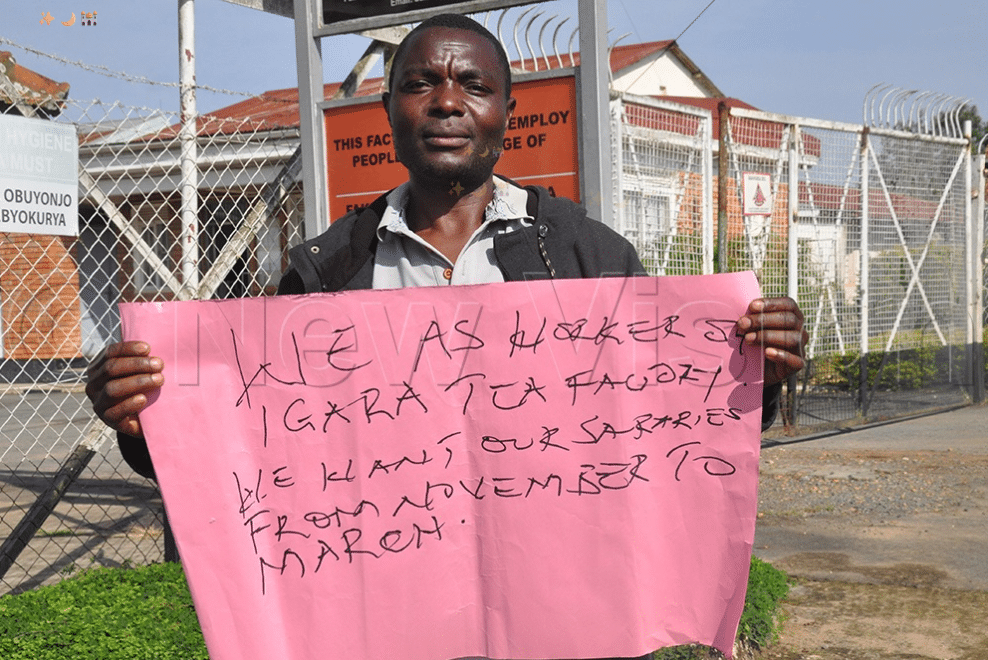
A worker at Igara Tea factory, Uganda, demands his salaries after months without pay. (Photo by Bruno Mugizi) New Vision, 17/3/2026
The Headlines
The women’s wing of an Indian trade union used the occasion of International Women’s Day to march for their rights to “higher wages, improved working conditions, and proper recognition of their work in society,” reminding the world that “without us, there is no tea…”
Several countries’ governments – including China, Ethiopia, India, Kenya, Sri Lanka and Vietnam – are making significant investments into their tea sectors and implementing reforms to strengthen them and improve conditions for producers. Common aims of these reforms include modernisation, adding value and boost farmer earnings, ramping up their competitiveness on the international market.
By contrast, Sri Lanka, still reeling from its recent string of political, economic and environmental catastrophes, is struggling to support its tea workers and farmers; 100 days after Cyclone Ditwah 60,000 people from the Malaiyaha Tamil community remain displaced.
Three of India’s key tea producing states – Assam, Kerala and West Bengal – are due to hold legislative assembly elections this month which is having knock-on effects in other states including wage comparisons and the return home of migrant workers from their jobs in other cities to vote.
While the West Asia conflict is inevitably driving up fuel (including Liquid Petroleum Gas or LPG) and fertilizer costs, its impact on tea producing countries this month has been varied; India and Kenya are feeling the effects of fuel shortages and closed ports restricting export channels, while Sri Lanka is experiencing a hike in orders and its customers in the region stockpile tea.
There has been “a clear shift in worker expectations” of wage levels in Assam, India, with an adequate wage being seen as “a symbol of minimum dignity”. Wages of plantation workers in Kerala (South India) have been increased and in India’s Alipurduar district wage arrears are due to be repaid with interest – trade unions say this is a first. But a Ugandan tea factory’s workers are striking to demand payment of overdue salaries, jeopardising the livelihoods of the thousands of tea farmers who supply the factory.
The deadly impact of closures were felt in India, where four women from a closed tea plantation in India were killed and another three seriously injured while travelling to a neighbouring plantation for work.
Dilhan C Fernando, of Dilmah Tea, has spoken out about how “retail’s relentless discount culture is undermining tea growers and stripping plantations of the resources needed to stay sustainable…”, while recent developments in China demonstrate that consumers are willing to pay more for better quality and more convenient forms of tea, and the country is investing accordingly.
Climate extremes continue to be seen across the tea growing world, affecting producers and farmers; farmers in India’s Kangra valley are facing a long dry spell, while Bangladesh’s nearly four-month-long dry spell has just ended. Meanwhile, Kenya’s tea industry is turning to renewable energy and efficiency upgrades as rising power costs and tightening wood fuel supplies strain the economics of processing tea.
Mechanisation is often proposed as a way of replacing the people who pluck tea, but this month sees news from China of technology being harnessed not to replace pluckers, but to ease and enhance their work; they are using drones to carry the harvest down the mountain, cutting a tortuous half hour journey to just five minutes.
“Dignity, fair wages, and a secure future for our children… without us, there is no tea.”
This year’s coverage on and after International Women’s Day (IWD – March 8th) included some thoughtful pieces on the extent to which the industry values women – on whom it primarily depends for its existence and continued success, and saw some of the women themselves take action.
The women’s wing of an Indian trade union used the occasion of IWD to march for their rights.“Hundreds of tea garden workers in Assam’s Dibrugarh staged a procession on the lanes of Mohanbari Tea Estate for equal rights on Sunday. Under the banner of Assam Chah Mazdoor Sangha, the women workers raised slogans for higher wages, improved working conditions, and proper recognition of their work in society. On the occasion of International Women’s Day…. [the] Secretary of the women’s wing of the Assam Mazdoor Sangha said…”Today we march not just to celebrate womanhood, but to demand what is rightfully ours, dignity, fair wages, and a secure future for our children.”… “Today is our day to stand together and remind the world that without us, there is no tea…” The Daily Jagran, 08/03/2026
One of a series of three insightful articles in the run-up to the Indian elections (more on those below) focused on what governments need to do to ensure women’s rights are respected: “Women form 50–60 per cent of the plantation workforce and nearly 80 per cent of pluckers, the most labour-intensive task. Despite similar statutory wages, inequalities persist through job segregation, limited upward mobility, occupational health risks, safety concerns, poor sanitation, and inadequate access to healthcare, childcare and leadership opportunities…Women in tea estates occupy a unique position: they are central to the industry’s productivity yet face multiple vulnerabilities. Long hours of physically demanding work in plantations are combined with unpaid household responsibilities, creating a significant double burden. Health challenges such as anaemia, alongside risks of child marriage and trafficking in economically vulnerable communities, further underline the need for integrated health, education and social protection interventions.” (East Mojo, 19/03/2026)
Another article focused on GBVH – an issue which has recently been strongly associated with Kenya but which, in fact, is likely to affect all tea growing regions. “A November 2025 report by IDH and UN Global Compact Network Kenya, titled *From Risk to Resilience: Building Safe, Inclusive and Climate-Resilient Value Chains*, found gender-based violence widespread across Kenya’s agricultural sector… In many cases, job security is tied to compliance with male supervisors’ sexual demands. Tea estates recorded some of the highest prevalence, with two out of three women reporting sexual or domestic violence… Women remain concentrated in insecure, low-wage, and informal roles, conditions that heighten vulnerability. Climate stressors such as droughts and floods compound the risk further.” (Nation Africa, 01/03/2026)
THIRST and our partner organisation, Women Working Worldwide, are in conversation with key tea companies and organisations about collaborating to promote Dignity for Women in Tea. If you would like to know more or to join us, please contact us at contact@thirst-tea.org or caroline@women-ww.org.
Governments boost modernisation, diversification, adding value and farmer income
Several countries’ governments – including China, Ethiopia, India, Kenya, Sri Lanka and Vietnam – are making significant investments into their tea sectors and implementing reforms to strengthen them and improve conditions for producers. Common aims of these reforms include modernisation, adding value and boost farmer earnings, ramping up their competitiveness on the international market. While these reforms are welcome and much needed, these governments need to be talking to each other about the impact that their combined efforts will have on the global tea market. It is already struggling with oversupply of cheap, lower quality tea. If multiple governments of high volume tea producing countries now start simultaneously exporting higher value orthodox tea, it could have an equally depressing effect on prices leaving farmers and workers as badly off as before.
“The government of Kenya is implementing sweeping reforms to revamp its tea sector, aiming to boost farmer earnings to Sh100/kg by 2027 by tackling low auction prices, high production costs, and increasing value addition. Key strategies include Sh3.5 billion in factory modernization, promoting Orthodox tea production, digitizing payments, and removing VAT on tea exports,” said PS Ronoh. (Kilimo News, 23/03/2026). In addition, “The [Kenyan] government has released Sh3.5 billion to refurbish and modernise 19 tea factories owned by small scale farmers to meet the internationals standards. The funds have been disbursed to the Kenya Tea Development Agency (KTDA) affiliated factories to also enable them do value addition on tea for better prices at the tea auction centre in Mombasa. (The Star, 19/03/2026) Alongside the government reforms, “The Kenya Tea Development Agency (KTDA) has unveiled a reinforced institutional reform initiative aimed at strengthening governance structures, enhancing compliance mechanisms, and advancing its Farmers First commitment through a strategic partnership with the Kenya Institute for Public Policy Research and Analysis (KIPPRA)…[whose] CEO stated that the reforms are structured around measurable outcomes for smallholder farmers—improved revenue management, enhanced marketing performance, greater transparency, and sustainable returns.” (MSN, 09/03/2026)
“Five Chinese ministries [have] jointly issued new guidelines for the tea industry, outlining a plan to develop a 1.5 trillion yuan ($216 billion) sector by 2030, featuring stronger brands, modernized supply chains, diverse product categories, and globally competitive companies. The strategy [is] an effort to shift the industry’s focus from bulk production to higher-value segments across the tea value chain…in western provinces… where tea cultivation has become a key part of rural development and poverty reduction… Instead of just increasing production, Chinese planners are focusing on product diversification, brand growth, modern distribution systems, and higher-value tea products…government support for rural revitalization, agricultural modernization, and food-industry innovation is channeling investment into tea processing, technology, and branding.” (World Tea News, 11/03/2026)
In Vietnam, one “locality will stabilize and develop a concentrated raw material area of approximately 100 hectares; restructure the tea varieties, reduce the proportion of old tea varieties, and increase the area of high-quality varieties… striving to achieve over 80% of the area planted with high-quality varieties by 2030. At the same time, it will gradually apply production processes according to VietGAP and organic standards and apply technology in managing the growing areas… the processing stage is also being upgraded towards product diversification, developing specialty teas, premium teas, and organic teas, increasing the rate of deep processing to approximately 20-30% by 2030. (Vietnam.vn, 31/03/2026)
The central government of India: “is set to roll out a comprehensive package for the country’s tea industry shortly to revive the ailing sector, which is grappling with climate change and ageing plantations. The govt also plans to leverage the free trade agreement with the European Union to boost tea exports to the European market.” (Times of India, 06/03/2026) However, the Assam (state) government’s roll-out of land allocation to tea plantation workers continued to be met with resistance by the industry The Tea Association of India, who “welcomed the government’s intent to provide land deeds to plantation workers [but] said that many tea gardens have mortgaged their land as collateral for loans, and transferring such lands may create financial and legal complications.” (The Hindu, 30/06/2026). Meanwhile, “The government of [the Indian state of ] Tripura has unveiled plans to establish a dedicated tea auction hub, aiming to empower local tea growers and streamline the marketing process. Moreover, this initiative is expected to reduce dependency on external markets while improving price realization for producers… the move is being widely seen as a game-changer for the tea industry in the region.” (Borok Times, 24/03/2026)
By contrast, Ethiopia’s reforms involve tea in a broader, environmental initiative: “Launched by Prime Minister Abiy Ahmed, Ethiopia‘s Green Legacy Initiative is one of Africa’s most ambitious environmental and agricultural programs. Designed to combat deforestation, restore degraded lands, and diversify the nation’s agricultural economy, the program has seen billions of trees planted across the country. Central to its expanded vision is the deliberate cultivation of high-value crops, and tea has emerged as a flagship opportunity within that framework.” (STIR, 26/3/2026)
Sri Lanka struggling to support Tamil tea workers: 60,000 remain displaced
By contrast, Sri Lanka is struggling to support its tea workers and farmers – and is clearly still reeling from its recent string of catastrophes. These began with the economically motivated overnight banning of fertilisers – from which the tea industry is still recovering – political upheaval, and Cyclone Ditwah. These are in addition to the global impacts of the COVID 19 pandemic, the climate crisis, and now the West Asia conflict.
The government is making efforts to support cyclone-hit tea communities; “Sri Lanka’s Cabinet of ministers has approved a relief package to support the re-cultivation of export crops — tea, rubber, and coconut — following weather damage in late 2025, minister Nalinda Jayatissa said. Under the new relief scheme, the government will provide financial assistance to farmers based on the extent of their damaged land. The maximum relief amounts a hectare [include]:– Tea: Up to 500,000 rupees a hectare.” (Economy Next, 10/03/2026)”
But the assistance does not appear to be reaching everyone in a timely manner; “In plantation regions where slopes are already vulnerable to heavy rainfall, intense precipitation damaged crops and interrupted production. Workers dependent on daily wages tied to plantation output faced sudden reductions in income. These losses ripple outward through local economies. Farmers lose harvest income, plantation workers lose daily wages, transporters lose freight work and small vendors lose customers. The result is not simply economic slowdown; it is income interruption across entire communities. For households living close to subsistence levels, even a few weeks of lost income can be destabilising. Savings are limited. Insurance coverage is rare. Formal safety nets often fail to reach informal workers who make up a significant share of the labour force. The immediate response is predictable: households borrow.” (Groundviews, 13/03/2026)
In particular, “Sri Lanka’s Malaiyaha Tamil community continues to live in conditions of extreme precariousness months after the devastating passage of Cyclone Ditwah… last year… the Civil Society Collective for Malaiyaha Reconstruction (CCMR) denounced the slow pace of relief and reconstruction efforts in the affected areas, highlighting how plantation families have been left behind compared to other regions of the island…. Many displaced people are still living in temporary camps lacking essential services, such as drinking water and adequate sanitation. In some cases, around 50 families have to share just six latrines… More than 100 days after the cyclone, over 60,000 people remain displaced in the regions of Nuwara Eliya, Badulla and Kegalle…a petition with 15 demands addressed to the government and the president was presented…[including] the immediate provision of adequate temporary accommodation and a concrete plan for the construction of permanent housing.” (Asia News, 21/03/2026)
Elections in key Indian tea growing states raise expectations
Coincidentally, three of India’s key tea producing states – Assam, Kerala and West Bengal – are due to hold legislative assembly elections this month which is having knock-on effects in other states.
“The recent decision of the Kerala government to raise the daily wages of plantation workers to Rs 546 from April 1, 2026, has once again brought the issue of low wages in the tea gardens of North Bengal into sharp focus, with workers’ organisations demanding immediate enforcement of statutory minimum wages in the region. Tea garden workers across North Bengal, ahead of the forthcoming Assembly elections, staged demonstrations at the main gates of several plantations on March 9 and 10, raising a series of long-pending demands related to wages, employment security and welfare benefits., United News of India, 10/3/2026
People who have migrated away from tea plantations to earn better wages, are returning to vote; “The overlapping election timeline in the states of Tamil Nadu, West Bengal and Assam has prompted many migrant workers from the two states, currently employed in various sectors in the district, to return to their native towns. In Coimbatore, the impact is significant as a large number of people from Assam are employed in the tea estates of Valparai and areca nut (betel nut) processing and production units in the Thondamuthur constituency. Many are planning to take at least one month leave, citing that they need to cast their votes at their native place and spend time with their families… “We get Rs 450 per day and are offered free quarters. Compared to Assam, this is a better salary.” (New Indian Express, 21/03/2026)
Politically aligned trade unions are using the opportunity of the elections to push home their demands; “Amid the prevailing election atmosphere, the Trinamool Congress has launched a two-day protest programme from Monday, raising several demands concerning tea garden workers. The agitation is being organised across 139 tea gardens in Alipurduar and Jalpaiguri districts under the banner of the party-recognised Trinamool Cha Bagan Sramik Union (TCBSU)…a charter of demands comprising 10 to 18 points has been submitted in several gardens, including payment of pending Provident Fund (PF) and gratuity, improvement of labour quarters, supply of firewood and essential items, filling vacant posts and granting due promotions to workers.” (Millenium Post, 16/3/2026. See also Telegraph India, 8/3/2026)
Last month THIRST reported on two Sri Lankan MPs with roots in tea communities. The question of representation was similarly challenged last month in West Bengal, where “…tea garden workers have announced an independent candidate for the Kurseong Assembly Constituency… Sumendra Tamang’s candidature was announced on Sunday under the banner of Shramjivi Pahal… the representatives stated that workers in the region have long supported political parties by voting them into power, but their concerns have largely remained unaddressed… Sumendra Tamang… said that he has been actively engaged in social work and youth representation for over a decade.” (Millenium Post, 22/03/2026)
Varied impact of W Asia conflict on tea production and exports
While the West Asia conflict is inevitably driving up the cost of fuel (including Liquid Petroleum Gas or LPG) and fertilizer, its impact on tea producing countries this month has been varied:
In India, “Production of Darjeeling tea may face further decline due to a shortage of industrial LPG, the Darjeeling Tea Association has warned, highlighting the risk of supply disruptions to factories in the West Bengal district…Darjeeling tea estates have largely switched their factories from coal-fired systems to industrial LPG…This situation comes at a particularly sensitive time for the Darjeeling tea industry, which has been facing a prolonged production crisis.” (MSN, 13/03/2026)
Meanwhile, “Kenyan tea exporters are facing mounting losses as tea valued at approximately US$23 million remains stranded at the Mombasa auction for the third consecutive week due to disruptions caused by the ongoing Israel/US-Iran conflict. The crisis has been worsened by the closure of the Port of Salalah… a key logistics hub linking Kenyan tea exports to major markets including Pakistan, the United Kingdom, and several European countries… the continued disruption could significantly affect farmers… who depend on timely export markets. (Food Business MEA, 28/03/2026) “Sixty-five percent of our tea is consumed by Muslim-majority countries; this war affects their purchasing power and ends up reducing their orders. Farmers have to be ready for the worst,” [an] MP said. As a result of the failure to export tea, operations at the 71 KTDA-managed factories across the 16 tea-growing counties are likely to grind to a halt. (The Star, 16/3/2026)
But on the other hand, “The Sri Lanka Tea Board reports a surge in demand for Ceylon Tea from Middle Eastern countries amid ongoing regional tensions. Chairman Raj Obeyesekere said increased stockpiling of food in the region has driven demand, while prices have stabilized after an initial dip. The average auction price last week stood at Rs. 1,153 per kilogram, with unsold volumes remaining within normal levels… Officials say the overall impact on Sri Lanka’s tea industry is gradually easing, supported by measures to ensure fertilizer distribution and uninterrupted fuel supply for factories.” (The Morning, 25/03/2026)
Adequate wages “a symbol of minimum dignity”
East Mojo reports on “a clear shift in worker expectations” in Assam, India. “A daily wage of ₹351 has emerged as a widely accepted benchmark—no longer just a political promise, but a symbol of minimum dignity… Workers are calling for more timely and structured wage agreements, and increasingly framing their demands in terms of a living wage—one that ensures dignity, security, and the ability to meet essential needs… Industry stakeholders often emphasise that wages cannot be viewed in isolation… estates provide housing, rations, healthcare, and other benefits… (East Mojo, 31/3/2026)
For example, the Tea Association Chair argues that “Unlike most sectors, [the law] imposes extensive statutory obligations on employers, adding significantly to overall costs- a factor acknowledged in past Wage Committee recommendations.” (Economic Times, 30/03/2026)
“These provisions remain important. However, economic realities have changed. Workers today face increasing cash expenses—whether for education, healthcare beyond estate facilities, or daily mobility. Variations in the quality and accessibility of services further complicate this equation. The issue, therefore, is not whether in-kind benefits matter, but whether they can substitute for adequate cash income in a changing economy.” (East Mojo, 31/3/2026)
Nevertheless, “…the [Kerala] Plantation Labour Committee has decided to increase the daily wages of workers by ₹48… The revised wage structure [was] set to take effect from April 1, with employers directed to implement the hike immediately. Additionally, as interim relief, workers will receive a one-time payment of ₹1,000. It has been clarified that ₹500 of this amount will be treated as a grant and will not be recovered by the management. According to trade union representatives, the struggle for a wage hike in Kerala’s plantation sector has been persistent, driven by the growing disparity between stagnant income levels and the soaring cost of living. (The Hindu, 8/3/2026)
We have seen in multiple News Updates over recent years, even the payment of the small cash wage has not always been met by tea companies. It is welcome news, therefore that “A bipartite meeting… brought relief to thousands of tea garden workers in Alipurduar district as it was resolved that dues would be paid with interest. Trade union leaders present at the meeting said this is the first time that interest would be paid to tea workers on outstanding wages. (Telegraph India, 19/03/2026)
The financial challenges faced by tea producers globally is highlighted in this month’s news from Uganda: “Igara Growers Tea Factory is one of the oldest tea processing plants in the region but has for years struggled with management disputes that have dragged the company into prolonged leadership battles and financial difficulties… The factory is currently struggling with billions of shillings in debt and has failed to pay both farmers and workers for about six months. As a result, many farmers have stopped supplying green leaf, further reducing production levels.” (Nile Post, 6/3/2026)
Furthermore, “Operations at Igara Growers Tea Factory Limited in Bushenyi district have ground to a halt after workers went on strike over four months of unpaid salaries, raising concern among thousands of tea farmers who depend on the facility… The employees say they have not received salaries since November last year, leaving many unable to pay rent, service bank loans, or meet basic household needs. Joseph Barugahare, one of the affected workers, said… “Landlords have chased some of us out, and banks are threatening to seize our property. Yet tea continues to be loaded for market sale,” he said… (New Vision, 17/3/2026)
Who pays the true cost of low priced tea?
Wages levels are driven by a number of factors, not least of which is the price of tea. Dilhan C Fernando, Chairman of Sri Lanka’s Dilmah Tea, has spoken out about how “retail’s relentless discount culture is undermining tea growers and stripping plantations of the resources needed to stay sustainable…” He suggests that “real change would require a shift in consumer mindset,” but suggests that “retailers have conditioned consumers to expect deep discounts.” But while consumers may welcome lower prices somebody has to pay the cost, “whether it is the soil, biodiversity, growers, or even consumers themselves when quality and safety are compromised.” (AgTech Navigator, 12/3/2026)
Recent developments in China demonstrate that consumers are willing to pay more for better quality and more convenient forms of tea, and the country is investing accordingly; “China’s appetite for premium teas is on the rise, fueled by demographic shifts and a growing appreciation for health benefits. The domestic market is projected to nearly double by 2035, thanks to higher incomes and increased consumer awareness. This shift is moving the market away from generic bulk teas toward value-added and specialty products… In 2025, value-added tea products such as tea bags, instant teas, and green teas saw revenue growth, even as average prices for bulk exports fell slightly. This trend demonstrates a willingness among consumers to pay more for quality and convenience, supporting the premium pricing of gourmet teas like Dianhong.” (101 Finance, 22/03/2026)
Such price increases may never reach the farmer producing the tea, but the government of Tamil Nadu, South India has recognised the need for better prices for its tea farmers, Accordingly, “…the state government has released Rs 8.5 crore for the 2023-24 financial year for supplying green tea leaves to Indco Tea Factories (ICTF) across the district… as there was a high chance then that farmers would switch their loyalty from Indco tea factories to private factories, which may lead to poor capacity utilisation…The supportive price had been set at Rs 2 per kg of green tea leaves (GTL) in 2023-24. A total of 4.26 crore kg of GTL had been supplied to the ICTF that financial year by GTL farmers [in order] to safeguard the livelihood and economic interest of small tea growers in the district. (New Indian Express, 5/3/2026)
Elsewhere, in Bangladesh, an individual farmer has found his own way of adding value to his output through diversification: “By utilizing the vacant spaces in his 22-acre tea plantation…Alam [Pradhan], has turned once-fallow highland into a high-yielding agricultural venture… Pradhan’s innovative approach focuses on planting various mango varieties, primarily as shade trees for the tea plants… “I want young farmers to move forward with modern agricultural methods,” he stated, noting that many locals now visit his garden for inspiration.” (BSS News, 13/3/2026)
Plantation closure leads to road deaths and injuries
THIRST seeks to cover all news items about the serious – often fatal – accidents that occur in the tea sector. While industrial and agricultural accidents are not confined to the tea sector, it is important to consider the underlying causes of the accidents. For example, last month, four women were killed and another three seriously injured by a car that “rammed into their cycles” in Alipurduar, India. The women – former workers on a closed tea plantation – were “travel[ling] to neighbouring tea estates to work as casual labourers…” Their fellow workers gathered at the site of the accident; “Alleging negligence and highlighting the prolonged closure of the tea estate, the workers… claimed that had the tea estate been operational, the women would not have been forced to cycle long distances for work and the accident might have been avoided.” (Telegraph India, 1/3/2026)
S Asian climate impacts and Kenyan mitigation efforts
Climate extremes continue to be seen across the tea growing world, affecting producers and farmers. In India, “An unusually prolonged dry spell in the Kangra valley has begun to make farmers and horticulturists concerned as the region has witnessed almost no rainfall in the past two months, posing a threat to tea plantations, fruit crops and drinking water resources… The Tea growers in Palampur and its surrounding regions fear that if the dry spell continues, it can adversely affect both yield and quality of tea during the coming season. The Kangra valley is known for its distinctive tea and the growers depend on the crop for their livelihood.” (Tribune India, 10/3/2026)
While in Bangladesh,“A long‑awaited rainfall in the Sylhet region today ended a nearly four-month-long dry spell, bringing relief to tea garden authorities and workers and raising hopes for improved production in the coming season. (The Daily Star, 13/03/2026)
Although these climate impacts are likely to to be caused by global actions, efforts are ongoing to reduce the local impact of tea production; “Kenya’s tea industry is turning to renewable energy and efficiency upgrades as rising power costs and tightening wood fuel supplies strain the economics of processing one of the country’s most important export crops…Tea processing is among the most energy-intensive activities in the Kenyan agricultural sector, with power and fuel accounting for roughly a quarter of black tea production costs. The six-month project is designed to produce a roadmap for phased energy transition across KTDA-managed factories, potentially creating one of the largest agro-industrial decarbonization efforts in East Africa. (Kenyan Wall Street, 9/3/2026)
Drones let each picker harvest more leaves in a day
Mechanisation is often proposed as a way of replacing the people who pluck tea.But this month sees news from China of technology being harnessed not to replace pluckers, but to ease and enhance their work. “Longjing Village has grown green tea for over a thousand years. This year’s harvest unfolds under the hum of a drone gliding over the slopes as a tea picker secures freshly plucked leaves onto a waiting rope…according to Qi Yingjie, chairman of the company. “Drones are fast, reduce labor and let each picker harvest more leaves in a day,”… While carrying leaves down the mountain on foot can take at least half an hour, a drone completes the journey in just five minutes. (Xinhua, 23/03/2026) In another part of China, tea worker, Sangye Drolma, reports that “Before, we had to carry the tea down the mountain by hand, and some gardens are even higher up and farther away. Spring rains often turn the roads into mud, making transport tough. Using drones is so much quicker and easier” (People’s Daily Online, 10/4/2025)
Share this update
Sign up for our monthly newsletter to stay in the know about human rights in the tea sector
Each issue of our newsletter includes:

A summary of the latest tea sector news

Upcoming THIRST events

THIRST news and updates

New reports and resources from our Knowledge Hub
Latest news, views and events
View all Upcoming Event
 Tea News Update
April News Update 2026
THIRST Tea News Update April 2026 A worker at Igara Tea factory, Uganda, demands his salaries after months without pay. (Photo by…
Tea News Update 
March News Update 2026
Effects of W.Asia conflict on tea; deadly impact of wage arrears; land rights protests persist; bad roads destroy jobs, health and dignity.